
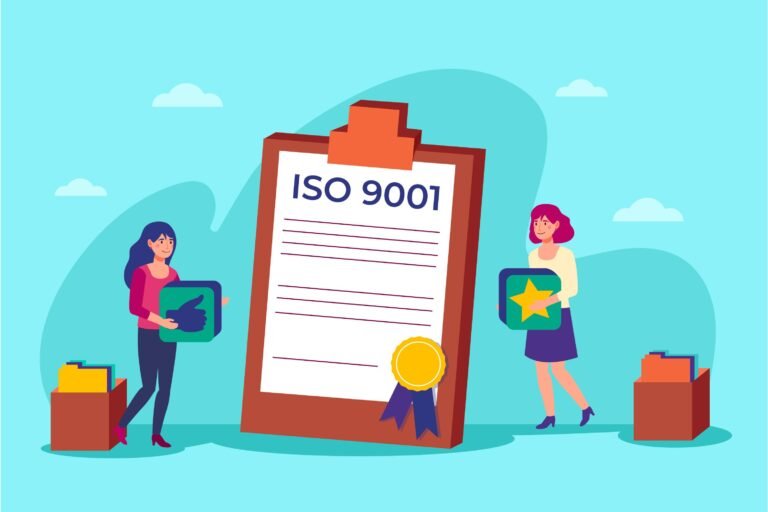
In the high-octane American business landscape, efficiency is often the difference between a market leader and a company struggling to stay relevant. “Flow” is the seamless transition of a product or service from concept to customer without the friction of errors, delays, or waste. To achieve this state of operational grace, organizations across the United States—from Silicon Valley tech startups to Midwest manufacturing giants—are leveraging the ISO 9001 quality management system as their primary strategic engine.
The Blueprint for Operational Excellence
The American market is defined by its scale and its demand for consistency. For a business to succeed across state lines and international borders, it cannot rely on the individual brilliance of a few employees; it must rely on a repeatable system. An ISO 9001 quality management system provides that blueprint. It forces an organization to document its core processes, identify critical touchpoints, and establish a “gold standard” for every output.
When a company successfully achieves ISO 9001 certification, it isn’t just hanging a plaque on the wall. It is signaling to domestic and global partners that its “flow” is backed by a internationally recognized framework of excellence. This certification acts as a universal language of trust in a B2B environment that increasingly demands verified performance.
Removing the Friction of Inefficiency
Friction in business often manifests as redundant meetings, excessive rework, or customer service failures. These “bottlenecks” kill momentum and erode profit margins. The ISO 9001 quality management system addresses these issues head-on by utilizing a process-oriented approach.
By mapping the journey of a service or product, management can identify exactly where the “clog” in the system exists. Is it a lack of clear documentation? Is it a failure in the supply chain? The ISO 9001 standard uses the “Plan-Do-Check-Act” (PDCA) cycle to ensure that these points of friction are not just identified but permanently removed. Consequently, ISO 9001 certification becomes an insurance policy against stagnation, ensuring the company is constantly evolving to be leaner and faster.
Why the USA Market Demands ISO 9001?
In the United States, the stakes for quality have never been higher. With the rise of complex supply chains and the increasing importance of federal and private contract requirements, having a robust ISO 9001 quality management system is often a non-negotiable entry requirement.
Whether you are aiming to win a Department of Defense contract or looking to become a preferred vendor for a Fortune 500 company, ISO 9001 certification provides immediate credibility. It proves that your organization has the maturity to handle high-stakes projects and the discipline to maintain quality under pressure.
From Compliance to Competitive Advantage
While some view the path to ISO 9001 certification as a hurdle of compliance, the most successful American CEOs view it as a competitive edge. Mastering flow through an ISO 9001 quality management system allows a business to:
- Reduce Operating Costs: By eliminating waste and rework.
- Enhance Customer Loyalty: By delivering a consistent experience every single time.
- Empower Employees: By providing clear roles and documented processes that reduce workplace stress.
Conclusion: Leading with Systemic Power
In 2026, the “move fast and break things” era has been replaced by “move fast with precision.” Mastering the flow of your organization is the only way to sustain rapid growth without collapsing under your own weight.
An ISO 9001 quality management system is the most effective tool available for creating that precision. By pursuing ISO 9001 certification, your business joins an elite group of American organizations that value systemic power over temporary luck. Build your flow, secure your quality, and let the standard lead your way to the top of the US market.